MCE 2026 arrives at a turning point for connected HVAC. Here are five trends shaping how equipment gets built, sold, and managed.
Published
March 24, 2026
Author
Henrik Holen
MCE (Mostra Convegno Expocomfort) runs March 24-27 at Fiera Milano. Over 1,800 exhibitors, 120,000+ professionals, and a new theme: "Energy is Evolving."
The name fits. HVAC is no longer just about heating and cooling. It's about energy optimization, regulatory compliance, and connecting equipment that was never designed to be connected.
Here are five trends we're paying attention to.
1. Building Automation Is a Legal Requirement
The revised EU Energy Performance of Buildings Directive (EPBD) must be written into national law by May 29, 2026, just two months after MCE closes. Building Automation and Control Systems (BACS) become mandatory for certain non-residential buildings. All new buildings must be zero-emission by 2030 (public buildings by 2028). Member states must plan for a complete fossil fuel boiler phase-out by 2040.
For HVAC OEMs selling into European markets, the conversation shifts from "should we add connectivity?" to "how fast can we ship it?"
MCE is dedicating pre-event programming to BACS and Energy Management Systems for exactly this reason, targeting facility managers, system integrators, and energy managers who need to understand what compliance looks like in practice.
2. Heat Pumps Need a Software Layer
EHPA (European Heat Pump Association) has a dedicated booth at MCE this year with events on certification, market trends, and EU policy. That's not new. The questions being asked are.
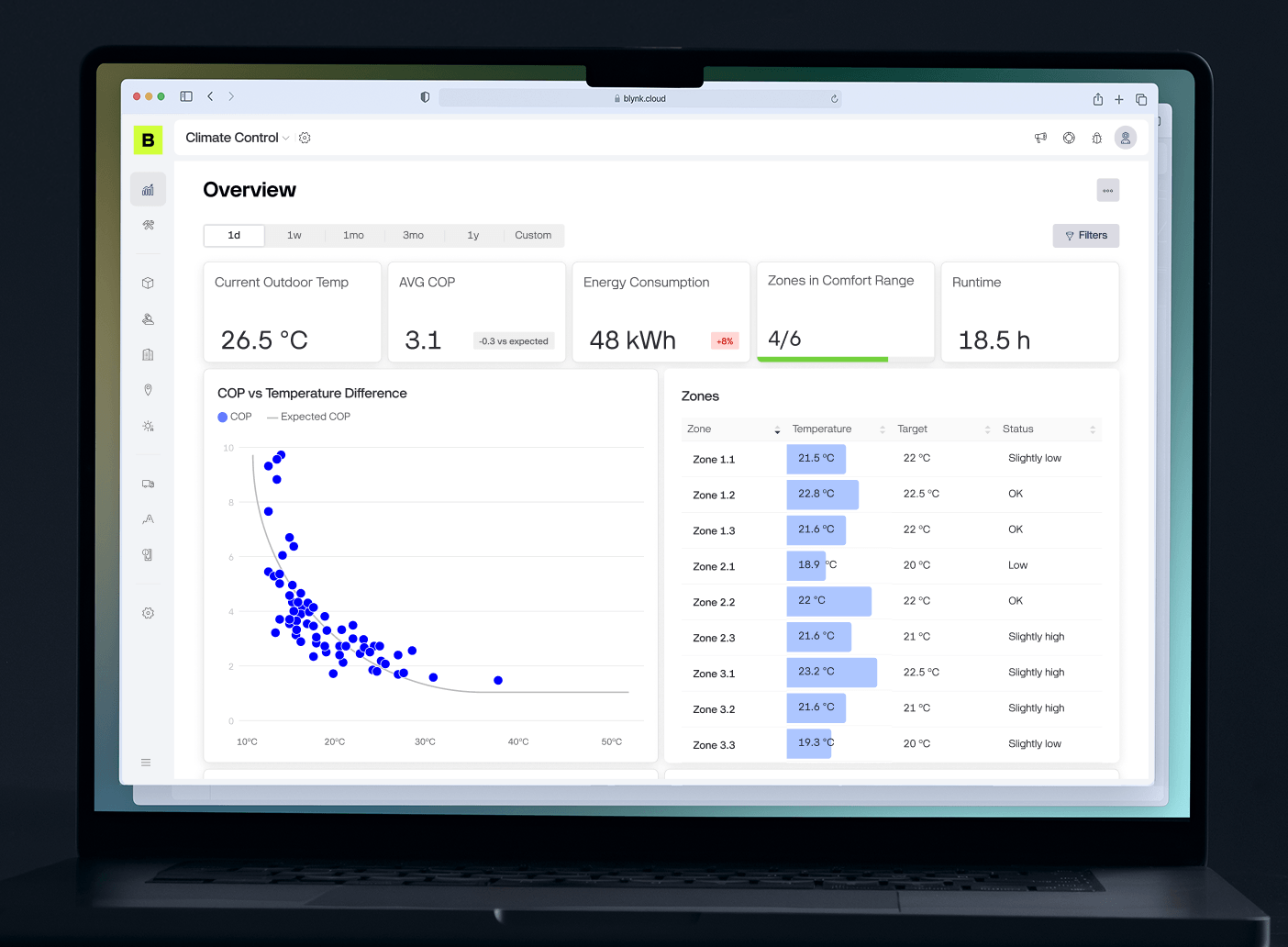
Heat pumps are more complex to manage than gas boilers. Performance depends on outdoor temperature, building load, solar and storage integration, and the coefficient of performance varies with conditions. Small configuration differences show up directly in energy bills.
Building-level BMS has existed for decades, but heat pumps push that monitoring need down to the individual equipment level. OEMs need to track COP across fleets. Installers need diagnostics beyond fault codes. Building managers need to optimize runtime across zones. Temperature monitoring is already the most common use case on the Blynk platform, and the shift we're seeing is from passive monitoring (is it running?) to active management (is it running efficiently?).
3. Wireless Is Gaining Ground for Retrofit
MCE's "That's Smart" zone in Hall 5, dedicated to smart buildings and building automation, is positioned at the center of the exhibition. Not tucked in a corner.
One exhibitor worth watching: Fantini Cosmi is showing a wireless multi-zone thermoregulation system built on LoRa radio technology, plus WiFi smart thermostats with humidity, CO2, temperature, and light sensors.
For retrofit scenarios, wiring is often the dealbreaker. Running new control cables through an occupied building is expensive and disruptive. LoRa handles range in large commercial buildings, works through walls, and can run on battery power depending on reporting frequency. WiFi covers shorter-range scenarios. Both lower the cost of connecting equipment that's already in the field.
4. AI Moves From Buzzword to Building Management Tool
MCE has dedicated programming this year to the AI and energy question: how AI optimizes energy consumption, and how HVAC infrastructure supports the energy demands of AI systems themselves (data center cooling is driving new product categories).
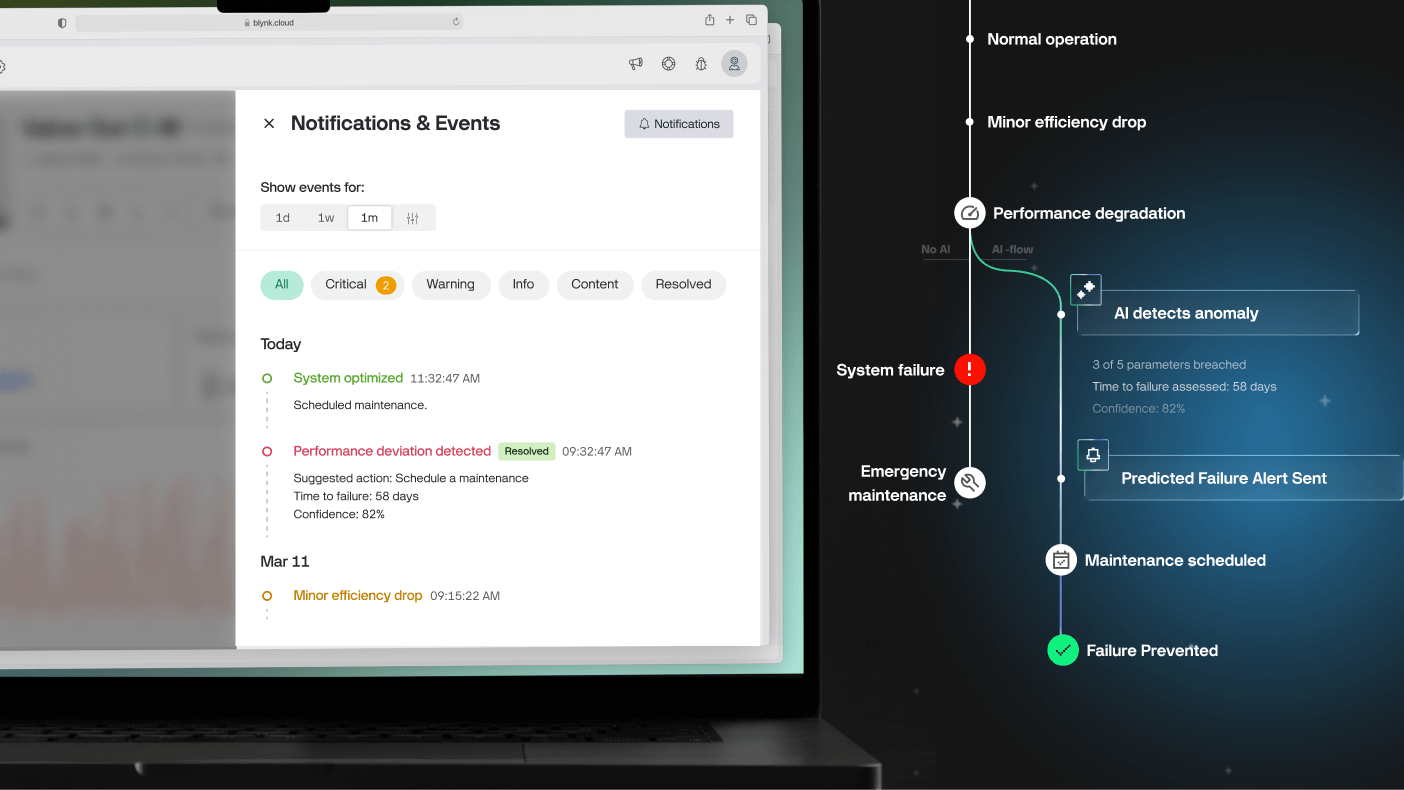
The more immediate opportunity: predictive maintenance. When we talked to HVAC leaders at Rheem, Mitsubishi Electric, and Comfort Systems USA last year, all three named it as their top priority. The shift from reactive alerts (unit failed) to predictive alerts (unit will fail in two months) requires connected equipment generating enough operational data to train models against. Every connected heat pump reporting operational data is contributing to that foundation.
For OEMs at MCE, the question isn't whether AI applies to HVAC. It's whether you're collecting the data that makes it useful.
5. The Fleet Management Gap
Connecting a single building to a dashboard is doable. Managing 500 buildings from that same dashboard is a different challenge entirely.
That means device provisioning at scale, firmware updates across different hardware, role-based access for OEM engineers, installers, building managers, and end users, plus data retention for both real-time monitoring and long-term analysis. Teams come in having built a working prototype, often on an ESP32 or similar microcontroller. It works great. Then they need to ship it to 200 customers with different access requirements, and suddenly they need user management, device templates, branded mobile apps, and over-the-air updates.
The companies closing this gap fastest aren't building custom infrastructure. They're using low-code platforms that handle provisioning, user management, and fleet operations out of the box, so engineering teams can focus on the HVAC intelligence that actually differentiates their product.
See You in Milan
Every piece of equipment on the show floor will eventually need a software layer for connectivity, monitoring, compliance, and fleet management. The companies that add that layer without diverting engineering from core product development will have an advantage.
We'll be in Milan looking for the products and partnerships that close the gap between great HVAC hardware and the connected experience that customers and regulators increasingly demand.
Sign up for a newsletter
Get latest news from Blynk
Over 500,000 people already signed up our newsletter. We never spam.
Thank you! Your submission has been received.
Oops! Something went wrong while submitting the form.






.png)