Root by Sepura: Award-Winning Composting Bin, Now with a Connected Experience to Match
Odor-free, mess-free food waste separation for the kitchen sink — now paired with an app that tells owners exactly what's happening under the counter and when their attention is needed.
Sepura Home is a Victoria, BC-based hardware company behind Root, a device that replaces both the garbage disposal and the countertop compost bin. Root separates solid food waste from liquids at the point of disposal — liquids drain normally, solids are diverted into a sealed, odor-controlled bin for composting.
The product has been recognized on TIME's 100 Best Inventions of 2020, featured at CES, and awarded a Core77 Design Award, with additional coverage from Forbes and Engadget.
When Great Technology Needs a Connected Experience to Match
Root hides a fair amount of engineering behind a simple sink hookup — and all of it operates completely out of sight, under the counter. Owners can't see bin fill level, filter health, or cycle status just by looking at the device, and without a companion experience, there was no way to get it onto a home network, keep its firmware current, or give users any real-time read on what it was actually doing.
Sepura wanted to solve several challenges at once:
Deliver seamless, user-friendly device activation — connect to home Wi-Fi without requiring any technical steps from the homeowner
Ship a sleek user-facing branded experience to match the product's premium positioning
Give users intuitive control over the device and automate maintenance — simple actions done via app interface.
Provide real-time visibility into device status for a unit that's physically out of view
Eliminate service visits for keeping device up to date — firmware updates pushed over the air to units already installed under a sink
Cut down on support calls by surfacing troubleshooting and calibration directly in-app
Choosing a Practical Path to Connectivity
Sepura's team didn't want to build a software department. They were looking for an IoT platform that would let them move fast — iterating quickly on both the underlying connectivity and the app interface — while their own team stayed focused on the hardware.
Beyond the practical fit, the values lined up too — Root is built around removing friction from a messy task, and that same obsession with a clean, effortless user experience is what Blynk brought to the table.
The Solution: Effortless Setup, Full Control, Real-Time Visibility
Hardware: Sepura proprietary hardware: ESP32 module driving servo motors, stepper motors, LEDs, and a sensor array
Connectivity: WiFi, provisioned through Blynk's device provisioning flow
Software: Blynk IoT Platform, Native iOS and Android Branded Apps, Enterprise Plan
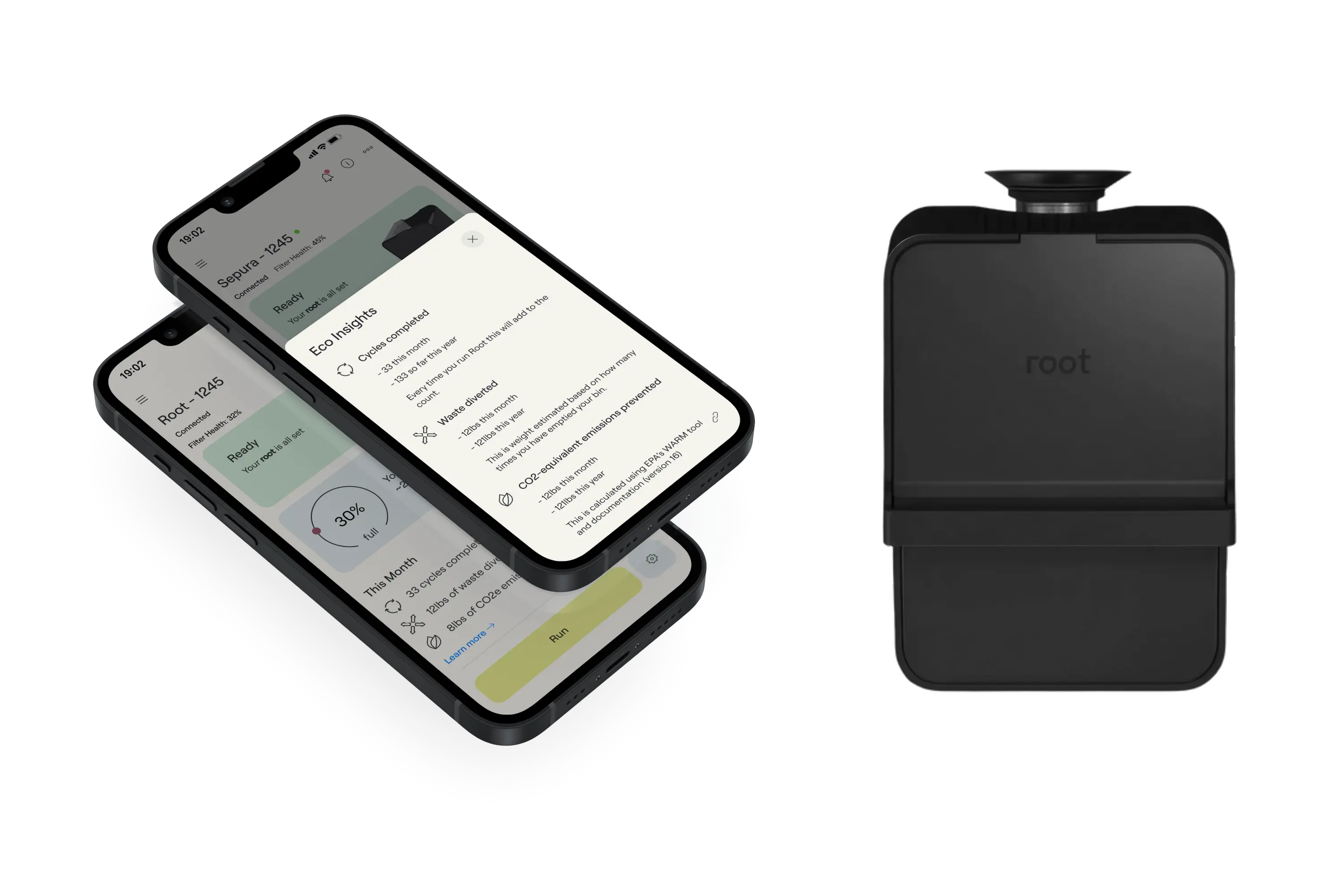
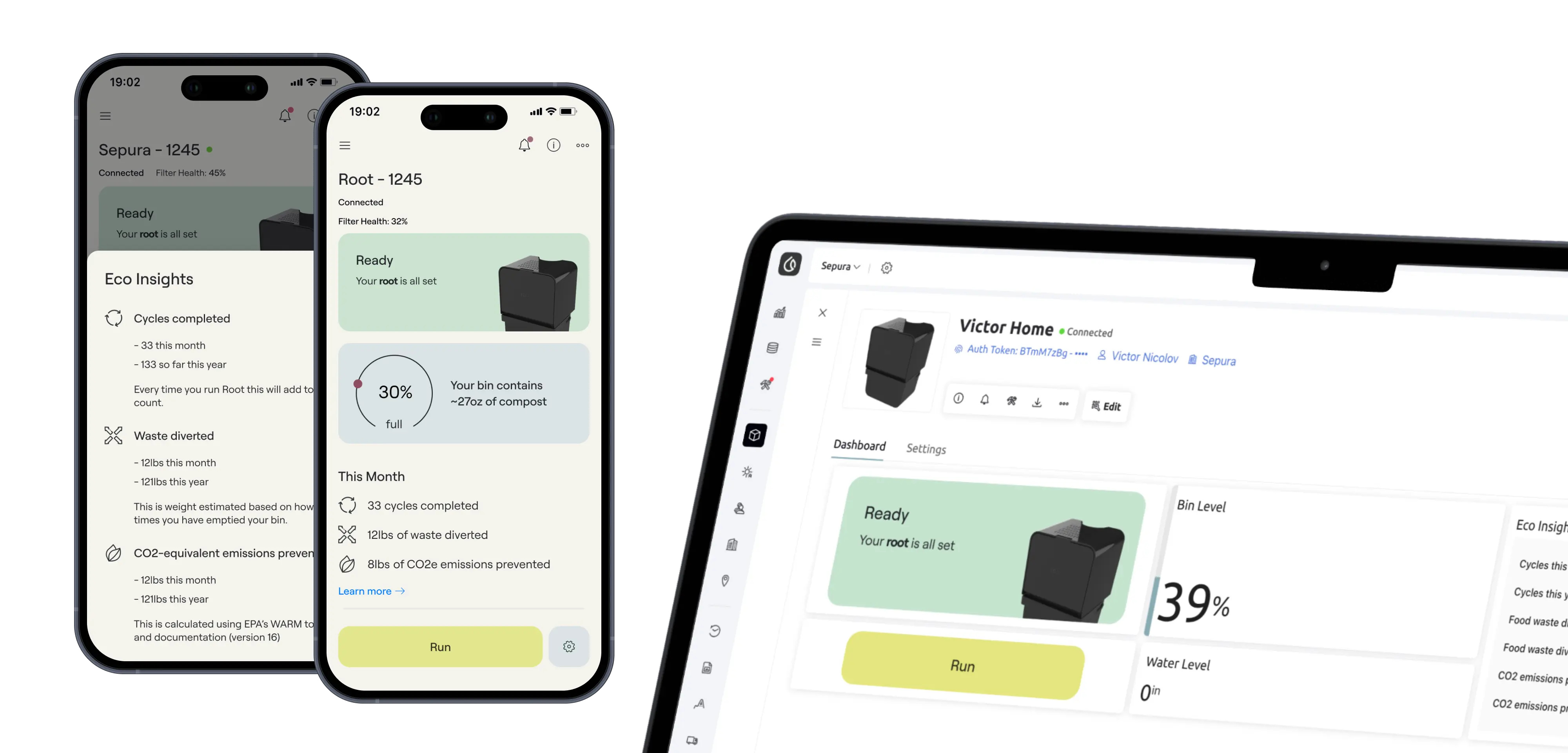
Using Blynk's managed platform, Sepura brought Root online without building activation, infrastructure, or a control layer themselves. The resulting app offers extensive list of functionality for their customers and the team, translated into a polished, branded experience:
Seamless device activation — any homeowner can activate a new Root unit in three simple steps, no technical skills required.
Over-the-air firmware updates — Sepura's team can push firmware updates and ship new features to units already installed under a sink, without a service visit
Full control at a tap — owners can run different modes like Separation, Cleaning, and Flooded Mode directly from the app, without ever touching the hardware
Real-time visibility — carbon filter health (tracked automatically), and bin fill level, shown as both a percentage and estimated volume
Eco Insights — cycle counts (monthly and year-to-date), pounds of waste diverted, and CO2-equivalent emissions prevented, calculated using the EPA's WARM tool
Calibration and pairing tools — sensor and valve-position resets, plus wireless button pairing, handled entirely in-app
Built-in support — troubleshooting guides and help resources surfaced directly in-app
Why Blynk Worked for Sepura Home
Blynk fit Sepura's reality as a small, product-driven team building complex hardware without a software department to match.
What stood out:
Low-code, no-infrastructure burden: No need to hire developers or backend team to maintain servers.
Fast, professional UX delivery: Early prototypes and rapid iteration through Blynk’s design process.
Enterprise-grade capabilities: OTA firmware updates, advanced automations, and multi-tenant device management – out of the box.




.png)